A tribute
The Sound Canvas
In 1991 a half-rack box with a little green-and-amber display changed how computers made music. Roland's Sound Canvas became the sound of General MIDI, of a generation of PC games, and of a whole bedroom-studio culture. This site, and the editor on it, exist because those sounds are still worth playing.
A standard in a box
At the start of the 1990s, MIDI files had a problem: a song written on one synthesizer played back with the wrong instruments on another. Program 1 might be a piano on one machine and a bass on the next. In 1991 the music industry agreed on General MIDI, a fixed list of 128 instruments, a standard drum map on channel 10, and minimum requirements for polyphony and multitimbral playback.
Roland launched the SC-55 Sound Canvas alongside it, together with its own superset of the standard, GS. GS kept everything General MIDI promised and added the things musicians actually wanted: variation tones, extra drum kits, and real-time control of the sound and effects. Because a GS module plays any General MIDI file correctly, the Sound Canvas quickly became the reference that composers wrote for, and that many listeners heard their MIDI music on.
The SC-55 also came as the SCC-1, an ISA card for IBM-compatible PCs. Later the SCB-55 daughterboard plugged onto other sound cards, giving a plain FM card real sampled instruments. That's how many people first heard a Sound Canvas: inside a beige tower, behind a DOS game.
The family
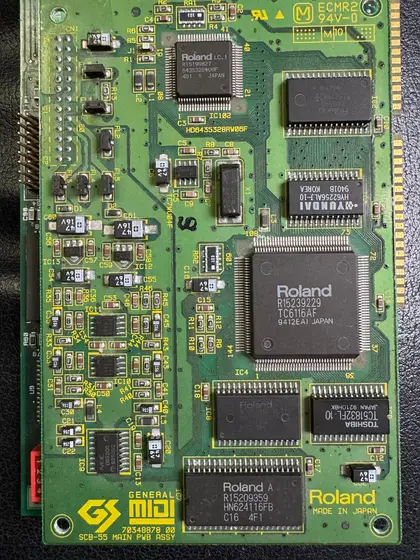
An SCB-55: a whole Sound Canvas on a card the size of a postcard.
| Model | Parts | Voices | Native tone map | Effects |
|---|---|---|---|---|
| SC-55 / SCC-1 / SCB-55 | 16 | 24 | SC-55 | Reverb, chorus |
| SC-55mkII | 16 | 28 | SC-55 | Reverb, chorus |
| SC-88 / SC-88VL | 32 | 64 | SC-88 | Reverb, chorus, delay, EQ |
| SC-88Pro / SC-880 | 32 | 64 | SC-88Pro | + insertion effect (64 types) |
| SC-8820 | 32 | 64 | SC-8820/8850 | + insertion effect |
| SC-8850 | 64 | 128 | SC-8820/8850 | + insertion effect |
Each newer model also carries the older tone maps, so songs written for an SC-55 still find their sounds.
GS: General MIDI, plus
General MIDI gives you 128 instruments. GS keeps those 128 as the "capital" tones and hangs variations off them, chosen with Bank Select (controller 0). Program 25 is always a nylon guitar in General MIDI, but on a Sound Canvas, bank 8 of that program gives you a ukulele. Ask for a variation the module doesn't have and it falls back to the capital tone, so a GS song never goes silent.
- Drum kits: channel 10 can switch between Standard, Room, Power, Electronic, TR-808, Jazz, Brush, Orchestra and SFX kits (and more on later models), and any part can be made a drum part.
- Sound shaping in real time: GS defines NRPN messages for each part's filter cutoff and resonance, envelope attack, decay and release, and vibrato rate, depth and delay. That's what made a General MIDI file sound produced rather than merely played.
- System exclusive: every parameter of the module lives at an address and can be set with a short Roland SysEx message. That's how this editor reaches every knob, how songs set themselves up before the first note, and how programs like CanvasMan let you save whole setups in the 90s.
- GS Reset: one message that returns the module to a known state, the first thing in nearly every GS song.
How a Sound Canvas makes sound
Every note you play starts a voice built from a few building blocks, Roland's classic synthesizer structure, the same one its pro synths of the era used:
- WG, the wave generator, plays back a sampled waveform from the module's ROM: a piano, a string section, a single cycle of a classic synth.
- TVF, the Time Variant Filter, shapes the tone's brightness, and can change it over the life of the note (more below).
- TVA, the Time Variant Amplifier, shapes loudness over time: how fast the note starts, how it decays, how long it rings after you let go.
- LFOs add movement: vibrato on pitch, and through the modulation settings, wah-like motion on the filter and tremolo on the level, reachable from the mod wheel, aftertouch and other controllers.
Some tones use two of these chains layered together, which is why a rich pad can take two voices and why the 24-voice SC-55 can run out of polyphony in a busy arrangement.
The Time Variant Filter
"Time variant" is Roland's way of saying it moves. A plain tone control sets brightness once. The TVF is a low-pass filter whose cutoff frequency is driven by its own envelope, so the brightness follows a shape every time a note plays. A brass tone opens up as it swells, a plucked string starts bright and mellows as it fades, and a synth pad slowly blooms.
What the editor's knobs do. Each tone has its own carefully voiced filter and envelopes inside the module. GS doesn't overwrite them. It lets you offset them per part, which is why the editor's values are centred on 0:
- Cutoff: brighter (+) or darker (−) than the tone's own setting.
- Resonance: emphasises the frequencies right at the cutoff for a more vocal, "synthy" edge.
- Attack / Decay / Release: speed up or slow down the tone's envelopes: slower attack for swells, shorter release for tight staccato.
- Vibrato Rate / Depth / Delay: the speed, amount, and fade-in time of the pitch LFO.
Try it: pick a pad, press Preview in the editor, and sweep Cutoff and Resonance while it plays. Map them to two knobs on your keyboard with LEARN, and you have the filter sweeps of a 90s trance record, coming out of a 1990s GS module.
Effects
Every Sound Canvas has two shared effects that each part feeds through its own send level:
- Reverb: rooms, halls, a plate, and two delay-style types. This is the "space" in a Sound Canvas mix.
- Chorus: four choruses, a feedback chorus, a flanger and short delays, for width and shimmer.
The SC-88 added a third send effect, delay, and a master equalizer. The SC-88Pro then introduced the insertion effect: one powerful multi-effect that selected parts pass through directly, with 64 types. Overdrive and distortion with amp simulators, phasers and auto-wahs, rotary speaker, compressors, pitch shifters, 3D effects, lo-fi, and multi-effect chains such as the guitar and keyboard multis. In the editor's Effects tab each type shows its real parameters, ranges and defaults from Roland's effect list.
Tone maps: keeping old songs honest
Roland faced a problem with every new model: if the SC-88's piano sounded different from the SC-55's, old songs would change. The answer was tone maps. A newer module carries its own native set of tones and also faithful maps of its predecessors' sets, selected per part with Bank Select LSB (controller 32): 1 = SC-55, 2 = SC-88, 3 = SC-88Pro, 4 = SC-8850. On an SC-880 you can set one part to the SC-55's Fantasia and the next to the SC-88Pro's version and hear how the sound evolved.
They're recreations, not copies: the newer engines, samples and effects give the older maps a cleaner, slightly different character. That's why an original SC-55 or SCB-55 is still prized for the authentic early-90s sound.
Legacy
For a decade, if a PC game shipped with MIDI music, there was a good chance it was composed on, and tuned for, a Sound Canvas. Owners of an SC-55 or SCC-1 heard those soundtracks the way their composers did, and the sound became part of many people's memory of the games themselves. In Japan, the SC-88 and SC-88Pro were the heart of the DTM (desktop music) scene, where hobbyists published intricately programmed MIDI arrangements, many of them built on the very GS parameters this editor exposes.
Roland's later Studio Canvas and the 2014 Sound Canvas VA plug-in carried the sound forward, and the original hardware remains loved, collected and repaired today. If you have one in a closet, plug it in. It still sounds wonderful.
Make some noise
Open the editor, connect your Sound Canvas, and go exploring.
Open the editor Share your story in the forumModel details are summarised from Roland's published specifications. Spotted something we got wrong? Tell us in the forum; this page is written by fans, for fans. Roland, Sound Canvas and GS are trademarks of Roland Corporation; this site is not affiliated with or endorsed by Roland.